
Created:
April 30, 2026
Updated:
April 30, 2026
In the sophisticated diagnostic suites of Harley Street and the private scanning centres of Leeds, the MRI is often viewed as the ultimate arbiter of truth - a photographic "proof" of injury or health. For the "Executive Athlete" navigating the pressures of global leadership, a "clear" scan is often met not with relief, but with profound frustration. This guide addresses the common clinical discrepancy where a patient’s physical experience of persistent discomfort has outpaced the technological limits of standard radiology. Clinical evidence in 2026 confirms that chronic pain is frequently a "software" issue rather than a "hardware" one. While an MRI is unparalleled at detecting a herniated disc, a torn ligament, or significant joint degeneration, it is fundamentally incapable of visualising the electrical "gain" of a sensitised nerve or the microscopic chemical "stew" of neuro-inflammation that keeps a system in a state of high alert. This article explores the biological reality of pain when imaging remains unremarkable, explaining why a structurally sound spine can still produce debilitating symptoms. At Excellence Health, we specialise in supporting the management of centralised pain volume. By utilising the Zenni Method, we move beyond the static image to recalibrate the living electrical system of the body. Whether you are navigating the high-stakes environment of London W1G or seeking discreet care in Cookridge, North Leeds LS16, our focus remains on restoring the integrity of nerve signaling. We provide a strategic path to support recovery for those whose symptoms remain invisible to traditional diagnostics, ensuring your biological operating system is as resilient as your professional ambition.

The Functional Assessment Protocol
The Zenni Method shifts the clinical focus from the static, often misleading question of "What does the tissue look like?" to the dynamic, real-time reality of "How is the nervous system behaving?" For the high-performing professional, the body often maintains a state of Neural Guarding - a functional "splinting" or bracing reflex. This reflex persists in the spinal cord long after a structural injury has physically healed. It is a protective software loop that the brain refuses to "shut off" because it hasn't received a high-fidelity signal of safety to override the perceived threat.
The "Shadow" on the Scan and the Clinical Gap

A frequent issue encountered in our W1G and LS16 hubs is the "incidentaloma" - a structural abnormality, such as a mild disc bulge or a touch of facet joint arthritis, that appears prominently on a scan but is not actually the source of the client's experience. Conversely, many clients have "pristine" spines on paper but suffer from intense, life-altering discomfort because their peripheral nerves are in a state of peripheral sensitisation (Link to: Blog 3 Chronic Sciatica). This creates a massive gap where the "hardware" (the MRI) fails to explain the sensory experience. This is precisely why a "normal" scan can be so psychologically taxing; it suggests the discomfort is unfounded, when in reality, it is simply a type of signalling that standard radiology is not designed to capture.
We use the Zenni Method to bridge the gap between static imaging and the lived experience of persistent discomfort. By introducing specific, low-frequency electrical cues, we facilitate a targeted recalibration of the neural environment. While traditional investigations may show unremarkable results, individuals with a sensitised system often report that this bio-electrical approach addresses the Nerve vs. Disc paradox (Link to: Persistent Pain Landing Page) in a way that structural repairs alone cannot. Rather than identifying a pathology, the Zenni Method provides a technical roadmap for system down-regulation. Our clients consistently report significant changes for the better, finding that this systemic reset helps resolve the "over-reading" of sensory input, allowing for a return to physical fluidity and elite performance that imaging alone does not facilitate.
Restoring the Signal of Safety
For the "Executive Athlete," the ultimate goal is to resolve the centralised pain volume (Link to: Blog 1 Central Sensitisation) that maintains this guarding reflex. We do not provide medical diagnostics; instead, we work closely with a client look to calm "noisy circuit". By providing the spinal cord with a stable, coherent bio-electrical signal, we facilitate a environment where the system can de-escalate. This is essential for those who have been told there is "nothing wrong" but find their physical capacity is severely bottlenecked.
By restoring nerve signalling fidelity (Link to: Blog 2 Bio-Electrical Signaling), we allow the brain to finally release the metabolic "bracing" that consumes so much of your daily energy. When the system is locked in a state of hyper-vigilance, it prioritises survival over performance. By introducing a signal of physiological safety through The Zenni Method, we support the transition from a defensive posture back to a state of fluid, efficient function. This is the hallmark of our approach in Harley Street and Cookridge: providing the nervous system with the proof it needs to stop running its "crisis" software and return to a baseline of calm, controlled strength.
IThe Biophysics of Invisible Pain: Beyond the MRI
To understand why pain remains a vivid, life-altering reality even when the physical tissue has seemingly returned to a state of health, we must look beyond traditional anatomy and into the sophisticated realms of the Neuro-Immune Axis and the phenomenon of Synaptic Gain. Central sensitisation is not a mere "feeling" or a psychological manifestation; it is a quantifiable, electro-chemical shift in how your spinal cord and brain process incoming sensory data.
Long-Term Potentiation and "Wind-Up"
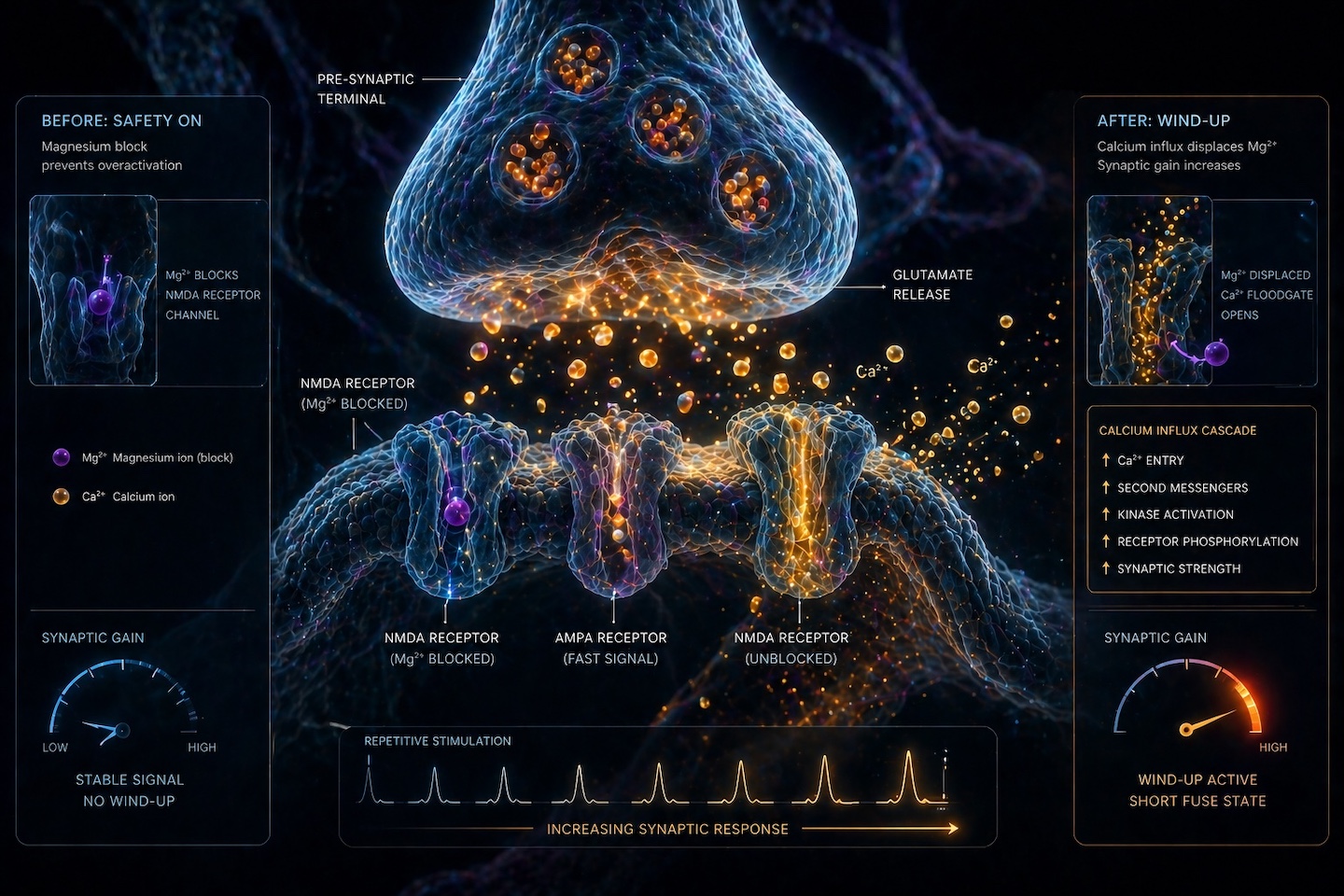
The fundamental principle of neuroplasticity - the idea that "neurons that fire together, wire together" - is the biological foundation of pain memory(Link to: Blog 5 Neuroplasticity). When a pain signal is fired repeatedly over months or years, the synapses in the dorsal horn of the spinal cord become increasingly efficient at transmitting that specific signal. This is a process known in biophysics as Long-Term Potentiation (LTP).
In essence, your spinal cord has "practised" being in pain until it can perform the task with minimal stimulus. This leads to the phenomenon of neural wind-up (Link to: Blog 11 Neural Wind-up), where the threshold for neural activation drops significantly. For the high-pressure professional, this means that even minor psychological stress, a lack of sleep, or a rise in environmental cortisol can trigger a disproportionate physical response. This represents a fundamental change in the "software" of the nervous system - the hardware (your joints and discs) may be intact, but the coding for pain has become the default programme.
The Glial Cell "Prime" and Neuro-inflammation
Modern 2026 clinical research identifies Glial cells - long thought to be mere "glue" for neurons - as the primary secret keepers of chronic discomfort. These cells act as the brain's internalimmune system. In a healthy state, they provide essential metabolic support; however, in a sensitised state, they become "primed" or "reactive." Once primed, Glial cells release a cascade of pro-inflammatory cytokines and chemokines that keep the neural environment"acidic" and hyper-reactive.
This creates a state of chronic neuro-inflammation that is invisible to a standard MRI but felt by the client as a relentless, diffuse ache or "burning" sensation. By providing a stable, low-entropy bio-electrical cue through the Zenni Method, we encourage these cells to return to their "resting" or anti-inflammatory phenotype. This addresses the biophysics of pain (Link to:Science & Evidence Page) at a cellular level, effectively clearing the chemical static that maintains the "Volume Knob" at its highest setting.
NMDA Receptor Modulation and Ionic Flux
The mechanical "gate" of pain in the spinal cord is largely governed by the NMDA receptor. Under normal physiological conditions, these receptors are blocked by magnesium ions, which act like a safety catch on a firearm, preventing excessive electrical flow. However, instates of central sensitisation, persistent neural depolarisation removes this magnesium block.
This allows a flood of calcium ions into the post-synaptic neuron, triggering a cascade of gene expression that "hard-wires" the sensitised state. Our protocols focus on helping the system return to its stable, negative resting potential, assisting the neural wind-up biophysics (Linkto: Blog 11 Neural Wind-up) to resolve by encouraging the natural magnesium block to re-seat itself. By restoring the electrical integrity through The Zenni Method (Link to: The Zenni Method Page), we provide the physiological "proof of safety" the spinal cord needs to re-engage its natural filters and stop the erroneous firing of pain signals.
Reversing Cortical Smudging
Finally, we must address the brain's "Sensory Homunculus" - the internal map of the body. In chronic pain, this map undergoes Maladaptive Plasticity, often called cortical smudging. The boundaries between body parts in the brain begin to blur; the area representing the lower back might "bleed" into the area for the hip or leg. This is why chronic pain often feels "diffuse" or "everywhere."
By introducing coherent, distinct electrical data through the Zenni Method, we provide the brain with the high-fidelity information it needs to "re-sharpen" its internal map. This re-differentiation allows the brain to accurately distinguish between healthy movement and genuine threat once again. This process is a critical component of restoring neurological vitality(Link to: Blog 33 Neurological Vitality), effectively overwriting the "Pain Memory" with a new, stable baseline of sensory clarity and nerve signalling fidelity (Linkto: Blog 2 Bio-Electrical Signaling). This systemic reset is essential for the"Executive Athlete" to reclaim the mental sharpness and physical fluidity required for elite leadership.
The Strategic ROI: Investing in Function over Form
For the discerning professional or high net-worth individual, the most expensive intervention is the one that addresses the wrong biological driver. In the high-stakes environments of Harley Street and the LS16 business corridors, efficiency is paramount; yet, relying solely on structural "patches" often leads to a diminishing return on investment. If a surgeon addresses a "bulge" or a "tear" with mechanical precision but ignores the fact that the brain and spinal cord have already transitioned into a sensitised state, the physical repair may fail to resolve the symptoms. This is the primary driver behind the "Failed Back Surgery" cycle - a poor Return on Health (ROH) that costs the executive significant downtime, physical trauma, and the formation of internal scartissue that can further tether sensitive nerve roots.
The Zenni Method offers a superior strategic ROI by operating as a non-invasive, systemic recalibration. By avoiding the surgical "burn rate" of lengthy recoveries and the potential for post-operative fibrosis, you preserve your physical agency and long-term structural integrity. This approach recognises that the body is a complex electrical circuit where the "software" often dictates the health of the "hardware." Instead of a temporary mechanical fix, we focus on a cumulative recalibration that builds systemic resilience.
Reclaiming the "Cognitive Tax" of Chronic Signalling
Furthermore, we must account for the "CognitiveTax" of persistent signalling. A brain stuck in a central sensitisation loop is a brain with a performance leak; it is constantly dedicating massive amounts of metabolic energy and neural bandwidth to processing a"threat" that no longer exists. This drain on resources directly impacts executive function, decision-making speed, and the ability to maintain a "flow state" during complex negotiations.
By resolving these neural fatigue symptoms (Link to: Blog 2Bio-Electrical Signaling), you reclaim the mental sharpness and decisive clarity required for elite leadership. We treat the nervous system as a learning organ rather than a collection of mechanical parts, providing the physiological evidence needed to stop the highly reactive systems (Link to: Blog 14 HighlyReactive Systems) from draining your professional potential. For the director in London W1G or the partner in North Leeds, this is an investment in professional longevity - ensuring that your physical state no longer acts as a bottleneck to your cognitive potential. This shift from"chronic management" to "neurological quiet" is the ultimate competitive advantage in a demanding global market.
Your Bio-Electrical Recovery: The London & North Leeds LS16 Hubs
Excellence Health provides a sanctuary for the over-sensitised system, located in the UK's premier professional hubs. We recognise that the environment of care is as critical as the treatment itsel ffor the discerning client.
The London Sanctuary (Harley Street, W1G): Our London W1G Clinic (Link to: London W1G Location Page)is designed for total discretion. In a city that is constantly"electrically noisy," we provide a "Sensory Fast" where the brain can unplug from the "London Load" of external stressors.
The North Leeds Sanctuary (Cookridge, LS16)

Located in the quiet, leafy suburb of Cookridge, our LS16 Leeds Hub (Link to: Leeds LS16 Location Page) serves ambitious clients who value non-invasive, science-led therapies. We emphasise how executive stress and cortisol (Link to: Blog 31Executive Stress) levels are maintaining your pain "volume," providing a high-efficiency recalibration away from the city centre's congestion.
Specialist’s Voice
Authored by: Jowita Penkala
"In my work as a specialist in The Zenni Method, I frequently consult with clients who have 'healed' physically according to their scans but remain in significant neurological discomfort. This diagnostic gap is where our expertise lies. By focusing on the biophysics of the action potential, we help our clients 'unlearn' the habit of discomfort by speaking directly to the nervous system's plastic pathways. It is about moving from a state of highly reactive systems back to a baseline of calibrated physical strength and electrical integrity."
Your Functional Assessment: Reclaiming the Edge
If your scans are unremarkable but your physical capacity remains restricted, it is time to move beyond structural guesswork and explore the possibilities of nervous system recalibration. We invite you to review our clients success stories ([Link to: Reviews Page]) to see how other professionals have reclaimed their competitive edge.
To discuss your history of persistent signal;ing and clear scans, we invite you to arrange a Private Consultation. During this bespoke consultation, we will evaluate your suitability for our protocols in London and North Leeds, ensuring you receive a sophisticated physiological roadmap tailored to your unique needs. This is the first step toward transforming your nervous system from a source of distraction into a high-fidelity instrument of performance.
· Harley Street (W1G) Assessment: [Link]
· North Leeds (LS16) Assessment: [Link]
Educational Disclaimer
This content is for educational purposes only and does not provide medical advice, diagnosis, or treatment. Complementary approaches are not a substitute for medical care. Always consult a qualified healthcare professional regarding persistent or concerning symptoms.
Author Attribution
Written by Jowita Penkala
Founder & UK Practitioner of the Zenni Electrostimulation Method
Practising from Harley Street, London